Stone Chimneys
"Stone chimney" can describe three very different structures: a chimney built of stone all the way through, a brick or block chimney faced with stone, or a framed chase covered in manufactured stone. Which one you have decides how it handles water and how it is repaired.
On this page
- Three structures that look alike from the street
- Clues to which one you have
- How water moves through each type
- Repointing stone is its own craft
- The flue matters more than the face
- The top of a stone chimney
- Stone around the fireplace opening
- Repair choices for stone chimneys
- Questions homeowners ask
- Sources
A stone chimney may be solid stone, natural stone facing over a brick or block core, or adhered manufactured stone veneer, which is a concrete product, sometimes over a wood-framed chase around a metal chimney. Solid and faced stone chimneys depend heavily on their mortar joints, which are often wide and need careful repointing with mortar softer than the stone. Manufactured veneer depends on hidden water-resistive layers and flashing. In every case, what is inside, the flue and its liner, matters more for safety than the stone on the outside.
Three structures that look alike from the street
Solid stone. The chimney walls are built of stone laid in mortar, sometimes rough fieldstone or rubble with irregular joints, sometimes cut stone (ashlar) with straighter, more regular joints. The stone is the structure.
Stone facing over a masonry core. A brick or concrete block chimney carries the flue, and natural stone is laid against it as an outer layer. The stone looks structural but is mostly cladding.
Adhered manufactured stone veneer. Cast concrete units shaped and colored to look like stone, stuck to a backing with mortar. The installation guide published for these products describes a layered system: water-resistive barrier, metal lath, a scratch coat, then the veneer set in mortar. The backing can be masonry, or a wood-framed chase that encloses a factory-built metal chimney.
The first two are masonry chimneys. The third may or may not be. If it is a framed chase, the chimney inside is a manufactured system with its own listing and rules; see masonry vs. factory-built chimneys.
Clues to which one you have
You can usually narrow it down from the ground and from inside the house.
- Look at the topA clay flue tile or masonry crown points to a masonry chimney. A flat metal chase cover with a round metal pipe and cap points to a framed chase around a factory-built chimney.
- Look where the chimney passes through the atticStone all the way through suggests solid stone. Brick or block with stone only on the outside suggests a faced chimney. Wood framing and sheathing mean a chase.
- Look at the baseManufactured veneer is normally finished at the bottom with a metal weep screed or flashing near the bottom edge. The installation guide calls for the veneer to stop at least 4 inches above soil or 2 inches above paving.
- Look at a chip or broken cornerNatural stone is the same material all the way through. Manufactured units can show a gray concrete body under a colored surface.
- Check the paperworkPermits, plans or a previous inspection report often name the chimney type and the appliance it was built for.
None of these is definitive by itself. Together they usually are, and an inspection settles it.
How water moves through each type
Solid and faced stone. Stones vary widely in how much water they absorb, but whatever the stone, a stone chimney usually has far more mortar per square foot than brick, especially with irregular rubble. The joints are the main path for water. Once inside, water can move toward the flue or down the inside of the chimney. On a faced chimney, water can also collect in the space between the stone and the core.
Manufactured veneer. This system assumes some water will get behind the veneer and is built to drain it out. The installation guide calls for two separate layers of water-resistive barrier lapped shingle fashion, corrosion-resistant flashing integrated with those layers, and a weep screed at the bottom. Its chimney chase detail shows flashing extending at least 2 inches beyond the chase and a cap that laps over the top of the veneer. When any of those layers are missing or reversed, water drains into the framing instead of out, and the damage stays hidden behind a surface that looks fine. Staining, soft spots or rot inside the house near a veneered chase deserve a prompt look.
The same guide warns against prolonged direct water exposure from sprinklers or downspouts, which is easy to fix by redirecting them.
Repointing stone is its own craft
The principles from brick repointing still apply, with some differences that matter on stone.
- Deeper raking. The National Park Service repointing brief notes that while most brick joints need old mortar removed to about 1/2 to 1 inch, stone masonry with wide joints may need mortar removed to a depth of several inches.
- Mortar weaker than the stone. General Services Administration procedures for repointing sandstone put it bluntly: replacement mortar must be weaker than the sandstone. The NPS brief applies the same logic to all historic masonry.
- Tools matched to the stone. The NPS brief says power tools may be more acceptable on hard stone such as granite or quartzite than on soft brick or soft stone. The GSA sandstone procedure does not permit power saws and grinders at all and calls for joints to be cut out by hand to twice their width, but not less than 5/8 inch.
- Curing. The GSA sandstone procedure calls for the new mortar to be kept damp for at least 72 hours.
Wide joints also make mortar color and texture far more visible than on brick, so sand and joint finish deserve attention. See chimney mortar types.
The flue matters more than the face
A stone exterior says nothing about the condition of the flue. In the 2003 International Residential Code, which Buckley Rumford Fireplaces reproduces online, masonry chimneys must have a lining suited to the appliance they serve, with options that include clay flue lining, listed chimney lining systems and certain other materials as options. A stone chimney is held to the same expectation as a brick one.
Older solid stone chimneys can have irregular interiors, multiple flues and offsets that make sweeping, camera inspection and relining harder to plan. A camera run up each flue, where its shape allows, is the way to learn what is actually there. If you are buying a house with a stone chimney, see buying a home with a fireplace; if a liner is needed, see liner options.
The top of a stone chimney
The top takes the most weather on any chimney, and stone tops vary widely: a poured crown over a stone stack, a large flat stone slab, decorative stonework around the flue tiles, or on a veneered chase, a metal chase cover. Whatever the style, the job is the same: shed water away from the joints below and keep rain out of the flue. Loose stones near the top are a fall hazard and a sign that water has been working at the joints. See crown vs. cap and, for framed chases, chase covers.
Stone around the fireplace opening
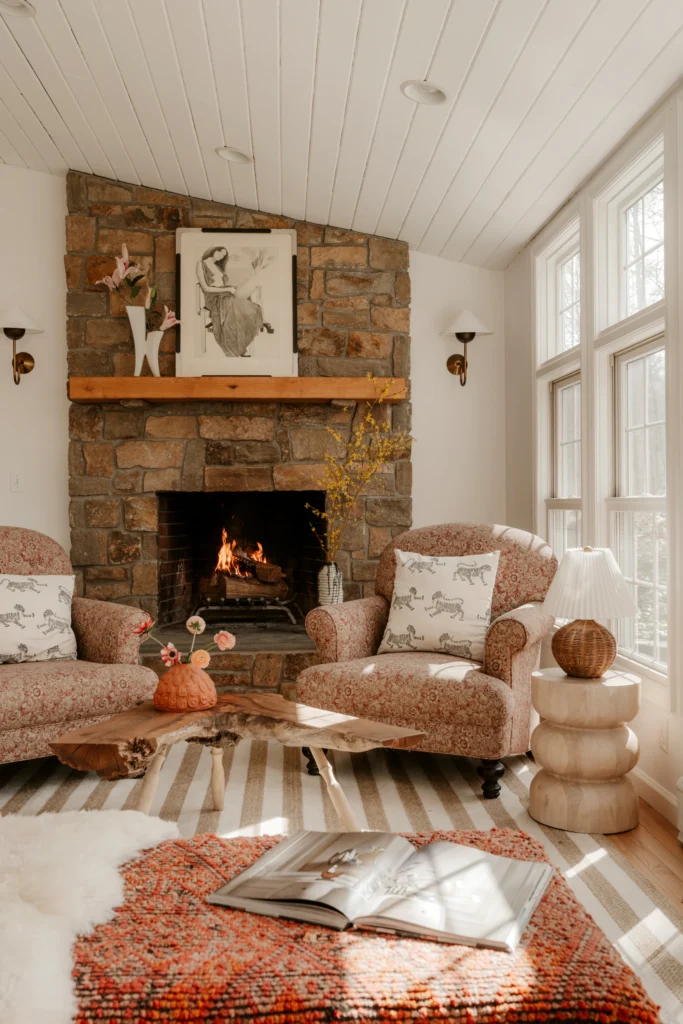
Stone fireplace faces are common inside the house, and the same distinctions apply. The firebox itself should be lined with firebrick laid in refractory mortar; the model code text calls for firebrick meeting ASTM C27 or C1261. Decorative stone belongs on the face around the opening, not in the fire chamber.
Manufactured stone has a specific warning: its installation guide says not to use it where it may be exposed to direct flame, such as a return into the firebox of a wood or gas fireplace, because heat can change the color and cause the mortar to dry out and crack. Clearances from the opening to wood mantels and trim apply no matter what the facing is; see clearances to combustibles.
Repair choices for stone chimneys
Repairs follow the structure:
- Solid and faced stone: repointing, resetting loose stones in compatible mortar, crown or cap work, flashing repair, and partial rebuilding of the top when stones have loosened over several courses. Salvaging and reusing the original stones keeps the chimney's appearance; finding a close match for missing stone can be difficult.
- Manufactured veneer: repairs often mean removing a section to reach and correct the water-resistive barrier, flashing or framing behind it, then re-installing veneer.
- All types: flue and liner work happens from the inside and usually leaves the stonework untouched, apart from what shows at the top.
On a house in a local historic district, visible changes may need review; see chimneys on historic homes.
When we assess a stone chimney, we identify how it is built, check the top, joints and flashing from the roof when it is safe, look at the attic side where accessible, and run a camera up the flue when it allows. You see the photos and our notes before any repair is planned. Related services: masonry repair and chimney rebuilding.
Questions homeowners ask
Is a stone chimney more durable than a brick one?
Not automatically. Durable stone is common, but a stone chimney has more mortar joints, often wider ones, and those joints are where water gets in. A well-built and maintained chimney of either material can last a long time.
Can manufactured stone be added over an old brick chimney?
Manufactured veneer can be installed over masonry, but it adds layers that have to manage water, and the installation guide's requirements for barriers, flashing and clearances still apply. It also does nothing for the flue. Have the chimney inspected first, and check with your local construction office about any permit.
Can an old stone chimney be relined?
Often, yes. The flue's size, shape and offsets decide which liner types can be installed, which is why a camera inspection comes first. See our guide to liner options.
Why are stones loosening near the top of my chimney?
The top courses take the most rain and freeze-thaw, and once the joints there erode, stones lose their bedding. A crown or cap that lets water into the top makes it worse. Keep people clear of the area below and have it inspected.
Tell us what you're seeing
Send a short description and a photo if you can. A team member will contact you to confirm a time.
Sources
- National Park Service, Preservation Brief 2: Repointing Mortar Joints in Historic Masonry Buildings (PDF)
- U.S. General Services Administration, Technical Procedures: Repointing Sandstone
- MSV Installation Guide: Installation Guide and Detailing Options for Compliance with ASTM C1780 for Adhered Manufactured Stone Veneer, 5th edition (PDF, hosted by Eldorado Stone)
- 2003 International Residential Code, Chapter 10, Chimneys and Fireplaces (text reproduced by Buckley Rumford Fireplaces)
This guide is general information. It can't diagnose a specific chimney; an inspection can.
Related
Masonry vs. Factory-Built Chimneys
A masonry chimney is built on site from brick, block or stone, usually with a clay or metal liner inside. A…
GuideChimney Mortar: Lime, Portland and Refractory
Chimney brickwork is laid with a lime-based mortar in older houses and a portland cement-lime mortar in newer ones; the…
GuideChimneys on Historic Homes
On older homes, chimney repairs should respect the original materials: mortar that is no harder than the original and…
ServiceChimney Masonry Repair and Repointing
Brick and mortar above the roofline take more weather than any other masonry on the house. When joints erode and brick…
ServiceChimney Rebuilding and Restoration
Sometimes the damage goes deeper than mortar joints and a few bricks. A rebuild takes down the failing section and lays…